Travel pass
Travel pass
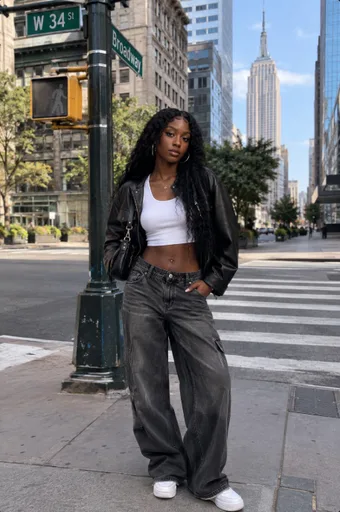
Text input**REFERENCES** @Image1 = the heroine. Preserve her exact identity, facial features, hairstyle, hair colour, skin tone, body proportions and outfit. She must remain the same recognizable person throughout the entire video. **CORE CONCEPT** Create a photorealistic travel sequence with the visual composition of a side-scrolling 2D platform game, but with completely realistic environments and physically believable materials. The heroine happily skips along a gigantic, real paper boarding pass that stretches horizontally across the frame like a wide elevated pathway. As she travels, the real-world locations behind her change from one country to another through seamless, physical page-turn transitions. The environments must look like actual places photographed with a real camera, not illustrations, paintings, game graphics or CGI landscapes. The boarding pass is the only surreal element in the scene; everything else follows photorealistic visual logic. **CAMERA — STRICT SIDE VIEW** Use a perfectly lateral, 90-degree side-on camera angle, perpendicular to the heroine's direction of travel. Show her in profile, moving continuously from left to right. The camera tracks sideways at her walking speed, maintaining a consistent distance, height and full-body framing throughout the entire video. The composition resembles a side-scrolling game, but the image quality and environments resemble a real high-end travel commercial. Keep the horizon, ground plane and heroine's direction of movement consistent. Use subtle, physically realistic parallax between nearby buildings, the middle-distance environment and distant landscapes. The camera must never orbit around the heroine or move in front of her. **0–2 SECONDS — DEPARTURE** A gigantic, photorealistic boarding pass extends horizontally across the frame. Its surface has realistic white paper fibres, subtle creases, perforated edges, printed airline information, a barcode and a clearly recognizable airport boarding-pass layout. The ticket is several times wider than the heroine and forms a continuous platform beneath her feet. The heroine enters from the left and begins skipping cheerfully along the ticket, with natural, light hops, relaxed arm movements and realistic clothing and hair motion. Each landing produces only a subtle, believable flex in the thick paper surface. Behind her is a realistic international airport exterior with glass architecture, terminal buildings and a commercial aircraft visible in the distance. Natural late-afternoon sunlight, physically accurate reflections and realistic shadows. The entire environment is photographic and grounded in reality. **2–4 SECONDS — TOKYO, JAPAN** As the heroine continues moving right, the enormous boarding pass bends upward at a perforated seam and turns over itself, like a massive physical sheet of paper. Its edge sweeps across the frame and temporarily obscures the background. As the paper passes, the airport is replaced by a photorealistic Tokyo street at blue hour, with authentic Japanese urban architecture, illuminated shopfronts, overhead cables, traffic and realistic neon reflections on the pavement. The new location is a real three-dimensional environment, not a picture printed on the ticket. Buildings have realistic depth, materials, reflections and lighting. The camera never changes angle, and the heroine maintains the same scale, direction and skipping rhythm. **4–6 SECONDS — VENICE, ITALY** The heroine reaches the next long seam in the boarding pass. The paper surface rises into a tall curved fold and rolls horizontally across the frame, revealing Venice in warm late-afternoon sunlight. Behind her are authentic Venetian buildings, old stone facades, arched bridges and a real canal with natural water reflections. The scene feels like a real location captured during a travel film shoot. The ticket remains a physical paper pathway in the foreground, with visible thickness, natural creases and believable contact shadows. The heroine continues skipping without interruption, landing naturally on the horizontal surface. **6–8 SECONDS — EGYPT** Another section of the boarding pass lifts and unfolds from the direction of the heroine's movement. The paper briefly fills the frame, then reveals a photorealistic Egyptian desert landscape with monumental pyramids, expansive golden sand, distant atmospheric haze and warm, low-angle sunlight. The pyramids must have realistic stone surfaces, scale, erosion and atmospheric perspective. The sand has natural wind-shaped ripples and believable shadows. Avoid fantasy architecture and artificial colours. The heroine continues her playful journey along the ticket, maintaining the same profile and screen position. **8–10 SECONDS — MEDITERRANEAN COAST** The final paper section curls upward and turns over in a single fluid motion, revealing a breathtaking real Mediterranean coastal landscape. White stone architecture sits on cliffs above deep turquoise water, with distant hills softened by atmospheric haze and warm sunset light. The boarding pass unrolls horizontally beneath the heroine, creating a long continuous pathway. She performs one final light, joyful skip and continues toward the right edge of the frame. The camera keeps tracking sideways as the realistic coastal scenery passes behind her. Finish while she is still moving, with a natural, uninterrupted sense of travel. **REALISTIC LOCATION TRANSITIONS** Every transition must be caused by the physical movement of the enormous boarding pass. Use believable paper mechanics: bending, curling, folding, rolling and turning along perforated edges. The moving paper temporarily covers the background, and a different photorealistic location is revealed immediately behind it. Make the transitions smooth and continuous, without ordinary hard cuts or dissolves. Never present the countries as images, illustrations, postcards, miniature dioramas or photographs printed on paper. They must appear as real, full-scale locations with convincing depth, natural lighting and consistent perspective. **HEROINE MOVEMENT** The heroine skips naturally from left to right throughout the entire sequence. Her movement is joyful and light, with small rhythmic hops, realistic take-offs and landings, natural arm swings and believable secondary motion in her hair and clothing. Her feet remain in contact with the paper when landing, without sliding or floating. She does not stop to pose, turn toward the camera or change direction. **PHOTOREALISM** Maximum photorealism in every location. Realistic architectural surfaces, stone, glass, asphalt, water, sand, paper fibres, natural shadows, reflections and environmental lighting. Authentic geographical appearance and a premium live-action travel-commercial aesthetic. The oversized boarding pass must look like a real physical object filmed in an actual environment, with believable material response and consistent light interaction. **STRICT NEGATIVE CONSTRAINTS** No cartoon style, no animation-style rendering, no illustrations, no hand-drawn scenery, no painted backgrounds, no game UI, no icons, no floating symbols, no decorative graphics appearing in the environment, no animated passport stamps, no particles, no sparkles, no magical transformations, no exaggerated visual effects, no miniature world appearance, no artificial plastic textures, no fantasy locations, no frontal shots, no three-quarter camera angle, no camera orbit, no camera rotation, no changes in camera height, no abrupt cuts, no changes to the heroine's identity, no outfit changes, no duplicated character, no unnatural jumping, no sliding feet and no warped anatomy. Maintain a strict side-on tracking shot, uninterrupted rightward movement, physically believable paper transitions and completely photorealistic locations from beginning to end.